What Makes a Great Photographer?
The Difference Between Taking Pictures and Creating Art We live in a photographic age. Less than two centuries after the world’s first recorded photograph, the medium has become so common that nearly...
The Difference Between Taking Pictures and Creating Art
We live in a photographic age.
Less than two centuries after the world’s first recorded photograph, the medium has become so common that nearly everyone now carries a camera in their pocket. Photography is no longer rare, technical, or reserved for specialists. It is constant. Instant. Disposable. A language of daily life.
We photograph our meals, our faces, our bodies, our lovers, our hotel rooms, our pets, our coffee cups, our reflections, and our own sadness. We document everything. We edit it. We post it. We delete it. Then we do it again.
In a culture built on selfies, stories, filters, and curated feeds, everyone has taken themselves seriously as a photographer at least once.
And yet, the sheer volume of images surrounding us raises an obvious question:
If everyone is taking photographs, what actually makes someone a great photographer?
What separates an image that is merely captured from one that lingers? What distinguishes a person who records a moment from an artist who transforms it?
The answer is not gear. It is not access. It is not even technical perfection alone.
Great photography begins where ordinary seeing ends.
We Are Surrounded by Images, But Not All Images Matter
One of the strange consequences of the digital era is that photography has become both more accessible and more forgettable.
We are flooded with images every day, yet very few stay with us.
Most photographs are functional. They prove something happened. They preserve a face, a place, a meal, a mood, or a passing impulse. There is nothing wrong with that. Photography has always had a documentary function.
But art begins when the photograph does more than record.
A great photograph does not simply show you something.
It makes you feel the presence of something.
That may be tension. Longing. Beauty. Alienation. Desire. Loneliness. Power. Vulnerability. Seduction. Distance. Stillness. Memory.
The strongest photographers do not just point the camera at the world. They decide how the world should be seen.
Composition Is More Than Arrangement
Like any visual art form, photography lives and dies by composition.
This is one of the clearest differences between the casual image-maker and the serious photographer.
An amateur often reacts quickly. They see something interesting and capture it before it disappears. Sometimes that instinct produces something remarkable. More often, it produces an image that feels accidental.
A great photographer is rarely accidental.
Composition is not just about placing subjects neatly within a frame. It is about control. It is about balance, tension, rhythm, space, interruption, proportion, and restraint. It is about deciding what belongs in the image—and just as importantly, what does not.
Where does the eye land first?
What is cropped out?
What creates pressure in the frame?
What creates silence?
What feels intimate? What feels distant?
In provocative or erotic photography, composition becomes even more powerful. A body can be made explicit or mysterious depending on what is withheld. A partial gesture can be more charged than full exposure. A shoulder, a mouth, a hand, the curve of a back, a stocking half-removed—these details can say far more than total revelation ever could.
That is where photography begins to understand desire.
Light Is Not Just Technical—It Is Psychological
If composition gives photography structure, light gives it mood.
Lighting is often treated as a technical issue, but in great photography it becomes something far more intimate. It shapes emotion. It creates atmosphere. It determines whether an image feels soft, severe, vulnerable, theatrical, detached, romantic, cold, or dangerous.
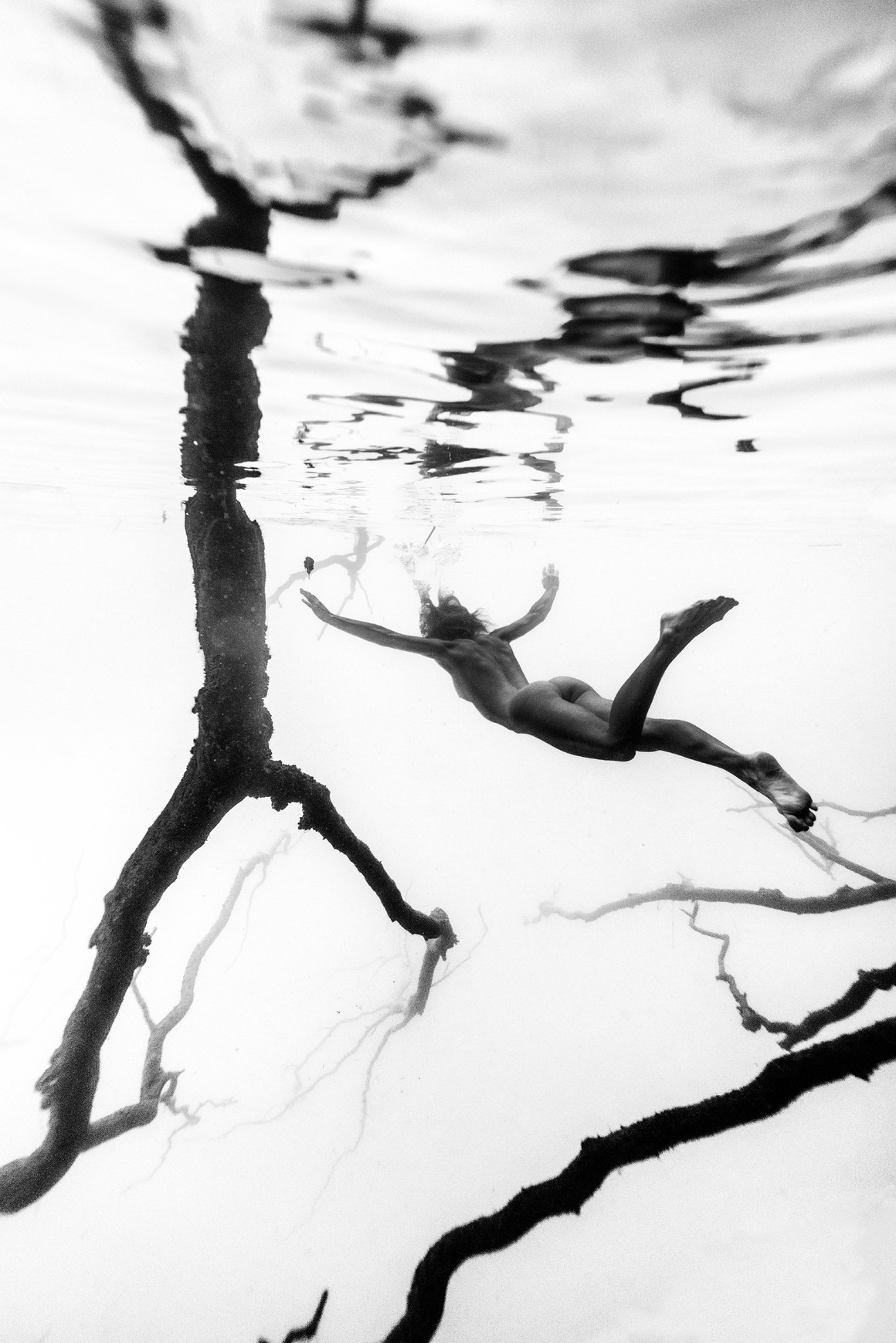
This is especially true in black-and-white photography, where light is stripped of the distraction of color and asked to carry more of the emotional weight.
In black-and-white, what is illuminated matters.
So does what disappears into shadow.
The line between revelation and concealment becomes sharper. Contrast becomes narrative. Shadow becomes tension. Skin becomes sculptural. The body becomes form, not just subject.
This is one reason black-and-white nude photography can feel more psychologically loaded than color. It often asks the viewer to look more carefully, and in doing so, it transforms the body from something consumed into something interpreted.
The best photographers understand this instinctively: light does not simply reveal. It seduces, obscures, withholds, and directs.
A Great Photograph Lets You Enter a Moment
The best photography has an almost impossible quality: it makes time feel porous.
You are not simply looking at an image. You are stepping into a moment.
Sometimes that moment is richly layered with clues. Other times, it is sparse and minimal. Either way, something in the image opens a psychological doorway. The viewer is invited into another atmosphere, another emotional state, another memory, or another version of reality.
This is what separates a strong image from a merely attractive one.
A great photograph may remind you of a person you once loved. It may trigger a private memory. It may feel like a scene from a film you were never in. It may create a sense of longing for a place you have never been.
The image becomes more than visual.
It becomes experiential.
This is also why provocative photography can be so powerful when done well. It does not need to show everything. In fact, it often becomes stronger when it does not. A tasteful glimpse, a charged pause, a suggestive angle, a body partially obscured—these can create more tension than exposure alone.
Mystery has always been one of photography’s most seductive tools.
The Best Photographs Do Not Just Impress—They Stay With You
Technical skill matters. Composition matters. Lighting matters. Timing matters.
But none of those alone are enough.
A truly great photograph leaves residue.
It lingers in the mind after you have looked away.
That is often the clearest sign that something meaningful has happened.
You may not even know why an image stays with you. Sometimes it is the tension in a face. Sometimes it is the emotional distance between two bodies. Sometimes it is the way a room feels almost too quiet. Sometimes it is the confidence of the gaze. Sometimes it is the sense that the image is telling you something without fully explaining itself.
This is where photography begins to cross into art.
A memorable image creates a relationship with the viewer. It invites projection. It opens interpretation. It resists being exhausted in a single glance.
In that sense, the best photographs are not always the most obvious. They are often the ones that refuse to resolve too quickly.
Inspiration Is One of the Truest Measures of Greatness
There is another quality great photographers share, and it is often overlooked:
Their images inspire.
That inspiration can take many forms.
Sometimes it pulls the viewer deeper into the emotional world of the image. Sometimes it awakens desire. Sometimes it sharpens curiosity. Sometimes it makes another artist want to experiment with composition, mood, framing, or narrative. Sometimes it simply reminds the viewer that beauty, tension, and meaning can still exist in a world oversaturated with content.
That kind of response does not come from trend-chasing.
It comes from conviction.
The strongest photographers are not simply making images for approval. They are translating a way of seeing. Their work reflects a real fascination with the body, the world, the human face, the drama of light, the architecture of desire, or the emotional charge of a fleeting moment.
And when that fascination is genuine, viewers feel it.
A powerful photograph often carries the photographer’s obsession inside it.
Why Most Images Fail
Most photographs fail for the same reason most art fails:
They are too easy.
They rely on novelty instead of vision. They imitate trends instead of developing a point of view. They overexplain. They overshare. They mistake exposure for intimacy and polish for depth.
This is especially visible in an era obsessed with visibility.
Today, many images are designed to be instantly consumed. They are optimized for reaction, not reflection. They are meant to stop the scroll for half a second, not to live in the imagination for years.
But the photographs we remember tend to resist that logic.
They are often slower.
Stranger.
More deliberate.
More sensual.
More unresolved.
They do not ask only to be seen. They ask to be returned to.
The Difference Between an Amateur and an Artist
The line between amateur and artist is not always technical.
It is often perceptual.
An amateur photographs what is there.
An artist photographs what is hidden inside what is there.
That difference can be subtle, but it changes everything.
It means the photographer is not simply documenting a face, but revealing something about power, fragility, vanity, distance, seduction, decay, memory, or longing.
It means the nude is no longer just a nude.
It becomes a study in vulnerability, control, fantasy, symbolism, or self-possession.
It means a room is no longer just a room.
It becomes atmosphere.
That is why great photographers—from Alfred Stieglitz to Helmut Newton, from Diane Arbus to Robert Mapplethorpe—continue to matter. Not because they owned cameras, but because they taught viewers how to look differently.
That is the real achievement.
Final Thoughts
In an age where everyone takes pictures, the rare image is the one that feels inevitable.
Not casual. Not disposable. Not merely attractive.
Inevitable.
As if it had to be made exactly that way.
That is what great photographers do. They do not simply capture the visible. They shape the invisible. They use composition, light, tension, restraint, mood, and instinct to create images that move beyond documentation and into something more lasting.
A photograph becomes art when it does more than show.
It reveals.
And in the most compelling work, it reveals something not only about the subject, but about the viewer too.
That is when an image stops being a picture.
That is when it begins to haunt.