Trust Your Own Eye
The Art of Being Your Own Critic The art critic was born at the precise moment art became public. As soon as exhibitions opened their doors beyond the aristocracy and private collections, a new figure...
The Art of Being Your Own Critic
The art critic was born at the precise moment art became public.
As soon as exhibitions opened their doors beyond the aristocracy and private collections, a new figure appeared beside the canvas: the self-appointed authority. When 18th-century exhibitions became accessible to a broader audience, so too did the need—at least for some—to explain art to everyone else. Or rather, to explain why everyone else might be looking at it incorrectly.
And so the art critic emerged.
Not merely as a commentator, but often as a gatekeeper. A curator of acceptable taste. A translator of meaning. A voice positioned just high enough above the crowd to make the crowd question its own instincts.
For generations, that role has shaped the way many people approach fine art. Instead of asking, What do I see? or How does this make me feel?, viewers are often trained to ask a different question first: What am I supposed to think about this?
That question has done real damage.
The Problem With Art Criticism Isn’t Criticism Itself
There is nothing inherently wrong with criticism.
Thoughtful interpretation can deepen our experience of art. Context can matter. History can matter. Technique can matter. A strong critic can illuminate something you may not have noticed and open a door into a work that seemed inaccessible at first glance.
The problem begins when criticism stops being an invitation and starts becoming a hierarchy.
Too often, art writing has functioned less as a bridge and more as a barrier. Instead of drawing people closer to the work, it teaches them to distrust their own eye. It suggests that meaning belongs to the initiated. That beauty, discomfort, power, eroticism, symbolism, or emotional reaction are somehow less valid unless filtered through approved language.
This is how art becomes less alive.
And this is also why so many people quietly believe they “don’t understand art.”
In many cases, what they really mean is that they were taught not to trust themselves around it.
The Rise of “Art Speak”
Over time, the art critic has become its own cultural caricature.
Once imagined holding court in salons and exhibition halls, today that figure is more likely to appear through dense essays, opaque catalog notes, or writing so overworked it seems determined to keep ordinary people at a distance.
There is even a name for this phenomenon.
Linguists have identified what some call International Art English—a strange dialect of inflated abstraction, vague theory, and self-important phrasing that often bears little resemblance to the way human beings actually speak.
Most people do not find art criticism difficult because they lack intelligence.
They find it exhausting because much of it is written to perform intelligence.
That distinction matters.
The purpose of “art speak” is often less about helping you see and more about reminding you who is supposedly qualified to see. It creates insiders and outsiders. It rewards fluency in a coded language. And, perhaps most importantly, it quietly persuades people that their own reaction is incomplete without professional validation.
That is where the whole performance begins to collapse.
You Can, In Fact, Be Your Own Art Critic
You do not need permission to look at art.
You do not need a critic to certify your emotional response.
And you certainly do not need someone else’s vocabulary before you are allowed to decide whether a work moves you, disturbs you, seduces you, repels you, or leaves you cold.
Art is not a test you can fail.
It is an encounter.
That encounter may be intellectual. It may be sensual. It may be psychological. It may be deeply personal. Sometimes it is immediate. Sometimes it unfolds slowly. Sometimes it reveals itself only after discomfort.
But the experience still begins with you.
That is why the most important critical tool you have is not specialized language.
It is attention.
Looking at Art Like a Rorschach Test
Consider the familiar Rorschach blot.
A psychologist may use it as a diagnostic tool, but for most people it functions as something simpler: an invitation to project meaning. You look at the shape and respond to what you see. There is no correct answer waiting in the wings. No curator appears to inform you that your reading is historically inaccurate. No essay arrives to explain why the blot must be understood through a specific school, period, or theoretical lens.
You look.
You respond.
That response is the point.
So why do so many people feel they must approach fine art differently?
A painting or sculpture may contain more layers, more history, more technique, more intention—but at its core, the process is not so different. You still begin by seeing what you see. You still begin with instinct, emotion, memory, desire, discomfort, fascination, resistance, or recognition.
Looking longer may reveal more.
Learning more may deepen the experience.
But none of that invalidates your first response.
Trust Your Eyes Before You Borrow Someone Else’s
One of the strangest habits people develop around art is apologizing for what they like.
They say things like:
- “I know this probably isn’t important, but I love it.”
- “I’m sure this is too obvious.”
- “I don’t really understand it, but I like it.”
- “I know this is supposed to be great, but I don’t feel anything.”
These are not failures of perception.
They are signs of conditioning.
We have been taught that our direct response is somehow less sophisticated than the approved one. Yet every honest relationship with art begins with the same basic act: you look, and something happens—or it doesn’t.
Whether you enjoy a work is personal.
Whether you recognize something compelling in it is another matter entirely.
That distinction is important.
You may dislike a work and still respect its power. You may admire a work and not want to live with it. You may find something unsettling, rough, or emotionally difficult and still understand that it is doing exactly what it intends to do.
This is where real looking begins.
When You Don’t Like the Work
Disliking a work of art is not a problem.
In fact, it can be more revealing than immediate admiration.
A better question than Do I like this? is often:
- Why does this bother me?
- Why does this leave me cold?
- Why do I find this crude, uncomfortable, or excessive?
- What expectation did I bring to it?
- Is the resistance aesthetic, moral, erotic, cultural, or personal?
That is criticism in its most honest form.
Not performance. Not jargon. Not posturing.
Just attention sharpened by self-awareness.
Art often becomes more interesting the moment you stop trying to prove you understand it and start asking why it affects you the way it does.
The Schiele Problem: Beauty, Desire, and Discomfort
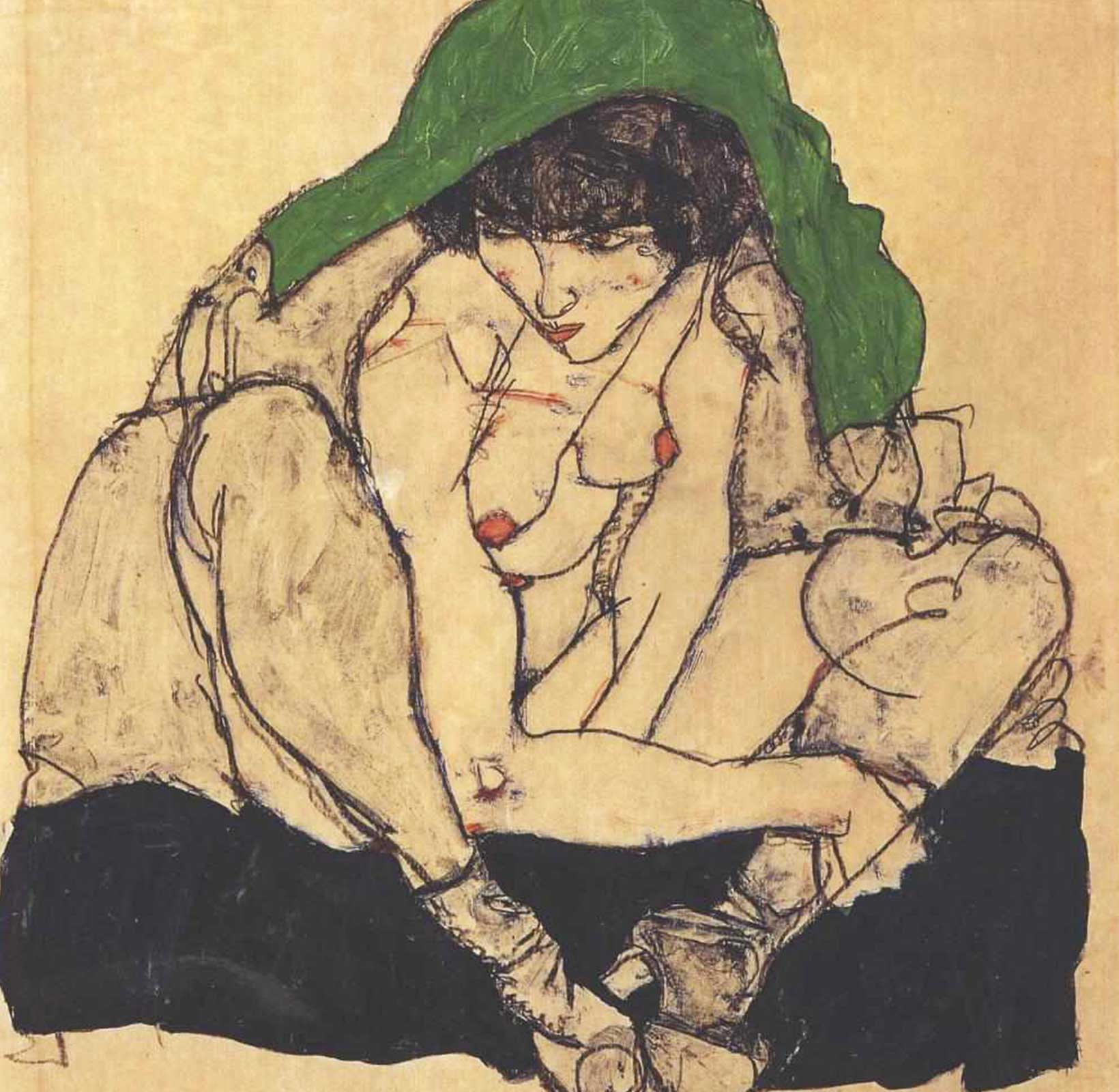
Take a drawing by Egon Schiele.
At first glance, you may not like it at all.
Perhaps the figure feels too raw. Too angular. Too exposed. Too psychologically unsettled. Perhaps the nude does not align with your personal idea of beauty. Perhaps it resists erotic fantasy rather than inviting it. Perhaps the line work feels harsh instead of graceful.
None of that means the work has failed.
And none of it means your reaction is wrong.
Erotic art, in particular, exposes how complicated our responses to the body really are. We are often taught to believe that a nude should be beautiful in a pleasing way, sensual in an obvious way, or desirable in a familiar way. But art is under no obligation to flatter our preferences.
A nude can be vulnerable without being seductive.
It can be tense rather than soft.
It can be psychologically charged rather than erotically inviting.
It can be difficult, awkward, confrontational, or unresolved—and still be deeply compelling.
This is where many viewers confuse personal desire with artistic value.
A work does not need to mirror your private fantasies to deserve your attention.
Appreciation and Attraction Are Not the Same Thing
This is especially important when looking at erotic or nude art.
A nude does not need to produce arousal in order to succeed as a work of art. In fact, some of the most powerful nude studies do the opposite. They challenge idealized beauty, complicate desire, or expose the body as something more fragile, strange, symbolic, or psychologically loaded than a simple object of attraction.
You can appreciate the structure of a figure without wanting it.
You can admire the honesty of a body without eroticizing it.
You can recognize the force of a work without calling it beautiful in any conventional sense.
This is where mature looking separates itself from passive consumption.
And this is precisely why erotic art is often so revealing: it does not simply show the body. It shows the viewer what they bring to the body.
Art Is Meant to Be Experienced, Not Performed
One of the quietest losses in the presence of art is pleasure.
Not necessarily pleasure in the sensual sense, though sometimes that too. But pleasure in the broader sense: curiosity, fascination, surprise, tension, delight, shock, emotional recognition, visual seduction, even the pleasure of discomfort.
When a critic hovers over your shoulder—literally or psychologically—that pleasure often disappears.
You begin monitoring yourself.
You become careful.
You worry whether your reaction is intelligent enough, informed enough, subtle enough, correct enough.
And suddenly, the work is no longer alive.
You are no longer encountering art.
You are managing your own performance in front of it.
That is not looking.
That is social anxiety disguised as cultural literacy.
The Freedom of Looking for Yourself
To be your own art critic does not mean rejecting all context, history, or informed interpretation.
It means refusing to surrender your first response.
It means understanding that expertise can enrich vision, but it should never replace it.
It means knowing that taste is not something handed down from above by a nervous man in a scarf speaking in abstractions.
It is something developed through attention, honesty, curiosity, and repeated encounters with the unfamiliar.
The more you trust your own eye, the stronger your taste becomes.
The more you look without fear, the more nuanced your reactions become.
And the more you allow art to disturb, seduce, confuse, provoke, or resist you, the more alive your relationship with it becomes.
Final Thoughts
You do, in fact, know what you like.
That is not something to apologize for.
The real challenge is not whether your taste is valid. The real challenge is whether you are willing to look closely enough to understand why you respond the way you do.
That is where art becomes personal.
That is where taste becomes intelligent.
And that is where the critic loses some of their power.
Look first.
Feel first.
Think after.
If the work still lingers in your mind—if it unsettles you, seduces you, confuses you, or keeps returning long after you have walked away—then it has already done something real.
No permission required.